
Blog
Infection Around Hip and Knee Prostheses

Hip and knee joint replacement surgery is considered one of the most successful orthopedic procedures for patients suffering from severe joint damage, osteoarthritis, and chronic pain. These surgeries significantly improve mobility, reduce pain, and enhance the quality of life for millions of patients worldwide.
Despite the high success rate of joint replacement procedures, complications may occasionally occur. One of the most serious and challenging complications is Infection Around Hip and Knee Prostheses, also known as periprosthetic joint infection (PJI).
Infection Around Hip and Knee Prostheses occurs when bacteria or other microorganisms affect the tissues surrounding an artificial joint implant. Although this complication is relatively uncommon, it can have significant consequences, including implant failure, tissue damage, reduced joint function, and the need for additional surgical procedures.
Early diagnosis and appropriate treatment planning are essential to control infection, preserve joint function, and improve patient outcomes.
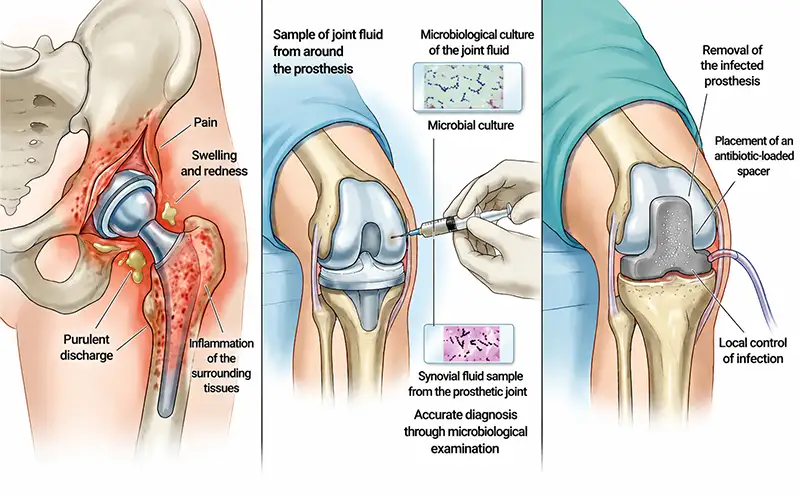
Symptoms of Infection Around Hip and Knee Prostheses
The symptoms of Infection Around Hip and Knee Prostheses can vary depending on the timing of infection development, the type of bacteria involved, and the patient’s overall health condition.
Common symptoms include:
- Persistent pain around the artificial joint
- Swelling around the affected area
- Redness and increased warmth of the skin near the surgical site
- Drainage or discharge from the wound
- Difficulty or discomfort during joint movement
- Fever and general signs of infection
In some cases, Infection Around Hip and Knee Prostheses may develop gradually with mild symptoms. Patients may only experience increased pain, stiffness, or reduced mobility without obvious signs of infection.
Because symptoms can be subtle, any unusual changes after joint replacement surgery should be evaluated by an orthopedic specialist.
Causes and Risk Factors of Prosthetic Joint Infection
Several factors may increase the risk of developing Infection Around Hip and Knee Prostheses. Understanding these risk factors helps physicians and patients take preventive measures.
Important risk factors include:
- Previous joint surgery
- Diabetes and poor blood sugar control
- A weakened immune system
- Obesity
- Smoking
- Poor wound healing
- Long surgical procedures
- Bacterial contamination during or after surgery
In some cases, bacteria can enter the bloodstream from another infection site and reach the artificial joint, causing infection around the implant.
Importance of Early Diagnosis
Early diagnosis is one of the most important factors in successful management of Infection Around Hip and Knee Prostheses.
If the infection is detected at an early stage, there may be a greater chance of preserving the implant through surgical cleaning and antibiotic therapy.
However, delayed diagnosis can allow bacteria to form a protective layer called a biofilm on the surface of the implant. This makes treatment more difficult because bacteria within biofilms are more resistant to antibiotics.
Patients should avoid taking antibiotics without medical evaluation because inappropriate antibiotic use before diagnostic testing may interfere with laboratory results and make identification of the infection-causing organism more difficult.
Diagnostic Methods for Infection Around Hip and Knee Prostheses
Accurate diagnosis of Infection Around Hip and Knee Prostheses requires a combination of clinical evaluation, laboratory tests, imaging studies, and microbiological analysis.
Blood Tests
Blood tests such as:
- C-reactive protein (CRP)
- Erythrocyte sedimentation rate (ESR)
are commonly used to detect inflammation and possible infection.
Elevated levels of these markers may indicate an inflammatory response and help physicians decide whether further investigations are needed.
Joint Fluid Analysis
One of the most important diagnostic methods is aspiration of fluid from around the artificial joint.
The collected fluid is examined for:
- White blood cell count
- Microorganism identification
- Bacterial culture
These results help determine the type of infection and guide antibiotic selection.
Imaging Studies
Imaging techniques may also be used to evaluate the condition of the implant and surrounding tissues. Although imaging alone cannot always confirm infection, it can provide valuable information about implant stability and bone condition.
Treatment Options for Infection Around Hip and Knee Prostheses
Treatment of Infection Around Hip and Knee Prostheses depends on several factors, including:
- Time since surgery
- Duration of infection
- Type of microorganism
- Implant stability
- Patient health condition
Treatment strategies may include antibiotic therapy, surgical cleaning, or revision surgery.
Antibiotic Therapy
Antibiotics are an essential part of treating Infection Around Hip and Knee Prostheses. However, antibiotic treatment alone is usually insufficient, especially in chronic infections.
Initially, antibiotics are often administered intravenously. After improvement and according to the patient’s condition, oral antibiotic therapy may be continued.
The duration of treatment depends on infection severity and response to therapy.
Surgical Treatment Approaches
When infection cannot be controlled with antibiotics and conservative methods, surgery may be required.
Debridement and Implant Retention (DAIR)
In selected early infections, surgeons may perform surgical cleaning of infected tissues while keeping the existing implant in place.
This approach is usually more successful when infection is diagnosed quickly and the prosthesis remains stable.
One-Stage Revision Surgery
In some cases, the infected implant is removed and replaced with a new prosthesis during the same operation.
This method requires careful patient selection and effective infection control.
Two-Stage Revision Surgery
Two-stage revision is one of the most common treatments for chronic Infection Around Hip and Knee Prostheses.
The procedure usually includes:
- Removal of the infected prosthesis
- Cleaning of infected tissues
- Placement of an antibiotic-loaded cement spacer
- Administration of antibiotic therapy
- Implantation of a new prosthesis after infection control
This approach has shown successful outcomes in many patients with chronic prosthetic joint infections.
Prevention of Infection Around Hip and Knee Prostheses
Although not all cases of Infection Around Hip and Knee Prostheses can be prevented, several strategies can significantly reduce the risk.
Preventive measures include:
- Maintaining proper surgical hygiene
- Following postoperative wound care instructions
- Taking prescribed medications correctly
- Managing chronic diseases such as diabetes
- Attending regular follow-up appointments
- Reporting unusual symptoms immediately
Patient education plays an important role in reducing complications after joint replacement surgery.
Follow-Up After Treatment
Long-term monitoring is essential after treatment of Infection Around Hip and Knee Prostheses.
Physicians usually evaluate:
- Pain reduction
- Joint movement improvement
- Inflammatory markers such as CRP and ESR
- Signs of recurrent infection
Regular follow-up helps detect possible problems early and improves long-term treatment success.
Conclusion
Infection Around Hip and Knee Prostheses is one of the most serious complications following joint replacement surgery. Although it occurs in a limited number of patients, its impact can be significant if diagnosis and treatment are delayed.
Successful management requires early recognition of symptoms, accurate diagnosis, appropriate antibiotic therapy, and, when necessary, surgical intervention.
With modern diagnostic techniques and advanced treatment strategies, many patients with Infection Around Hip and Knee Prostheses can achieve successful recovery and maintain good joint function after treatment.
For more information about hip and knee replacement surgery, orthopedic conditions, and advanced treatment methods, we recommend reading our other medical articles available on our website.